Backed by a Lifetime Motor Warranty.
.svg)


Adding custom motorized screens to your home is one of the most effective ways to upgrade your outdoor living space. Across the Tampa Bay region—where backyards, custom pools, and covered lanais serve as primary entertainment hubs—retractable exterior screens provide on-demand relief from intense sun, driving rain, and seasonal pests. They allow you to transform an exposed concrete slab or covered porch into a comfortable, climate-controlled extension of your indoor living room at the touch of a button.
However, because exterior motorized screens are high-performance mechanical systems rather than simple indoor window blinds, they require careful structural and environmental planning. Many homeowners treat motorized shades as a purely decorative purchase, leading to critical layout mistakes that compromise performance, shorten the system's lifespan, and result in expensive repair bills.
If you are planning an upgrade for your home, avoiding these common planning mistakes will ensure your investment provides smooth, reliable protection for decades.
The single most common mistake homeowners make when selecting an outdoor screen system is underestimating local wind forces. Your patio or lanai acts as a natural wind tunnel, catching coastal breezes and sudden afternoon thunderstorm microbursts. A vertical fabric screen measuring 15 feet wide by 10 feet tall functions exactly like a massive sail on a boat.
If you choose a system that relies on loose bottom weights, simple cable guides, or cheap hanging tracks, even a moderate 10 to 15 mph afternoon breeze will cause the fabric to billow wildly, rattle against your stucco pillars, and twist out of alignment. Over time, this constant movement strains the internal motor, frays the fabric edges, and can even tear the entire screen unit out of its mounting brackets.
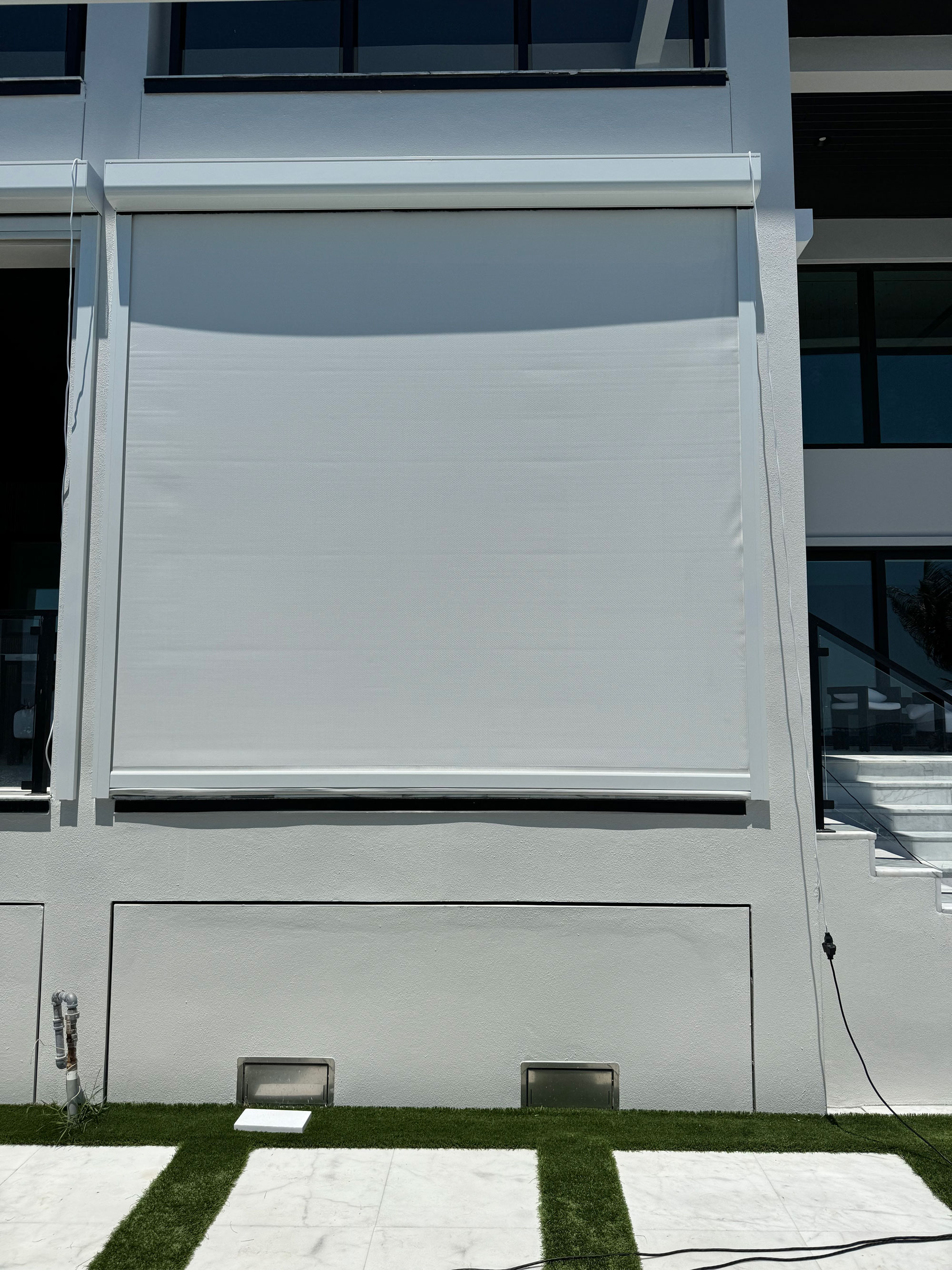
To prevent this, you must install an engineered, track-guided locking mechanism. These commercial-grade setups feature a continuous zipper bead welded directly to the vertical edges of the screen fabric. This bead rides securely inside a heavy-duty inner core channel housed within the exterior aluminum side tracks.
This continuous connection locks the fabric tight across the entire opening, distributing wind pressure evenly along the vertical tracks rather than concentrating the stress on the bottom corners. To understand the engineering differences between these track systems and how they protect your home, read our technical breakdown of the best stabilization for motorized screens.
Homeowners often pick their screen fabric based entirely on which color sample matches their house paint, ignoring the technical metrics of the weave itself. Outdoor screen fabrics are engineered with specific openness factors, which measure the density of the weave and dictate exactly how much light, heat, and air pass through the material.
Choosing blindly without analyzing your patio's sun exposure leads to immediate disappointment:
+-------------------------------------------------------------------------+
|                      Fabric Performance Characteristics                 |
+-------------------------------------------------------------------------+
|   [ Light Fabrics: White, Cream, Tan ]  | [ Dark Fabrics: Bronze, Black ] |
|   - Maximum Solar Heat Reflection       | - Superior Outward Visibility   |
|   - Brightens the Screened Space        | - Aggressive Sun Glare Control  |
|   - Higher Internal Visual Haze         | - Absorbs Heat (Higher Surface) |
+-------------------------------------------------------------------------+
To find the ideal balance between visibility, heat reduction, and airflow for your home's unique layout, read our comprehensive resource on patio shade fabrics explained: openness, color, heat.
In the Tampa Bay region, insect defense is usually a primary motivator for installing outdoor screens. However, assuming that any standard insect mesh will keep your patio bug-free is a critical planning error.
Standard pool cage screens and basic insect meshes are designed to stop large pests like flies, wasps, and mosquitoes. They feature a loose grid weave that is completely incapable of stopping Ceratopogonidae—commonly known as no-see-ums, biting midges, or punkies. These microscopic biting pests emerge in massive swarms during Florida’s humid spring and autumn seasons, easily passing through standard screens to ruin your evening patio gatherings.
If your property sits near salt marshes, dense mangroves, standing fresh water, or tidal rivers, you must specify a specialized micro-mesh fabric. These fabrics utilize an ultra-dense weave pattern containing more than double the threads per square inch of standard insect screen. This dense barrier completely stops microscopic biting insects while still allowing fresh air to ventilate through your patio enclosure.
To ensure you select a material capable of handling your neighborhood's specific pest pressures, check out our guide on choosing mesh for bugs: no-see-ums to mosquitoes.
Motorized exterior screens require steady, reliable electrical power to operate their high-torque internal tubular motors. One of the most expensive mistakes a homeowner can make is failing to coordinate the electrical layout prior to ordering and installing the screen system.
+-------------------------------------------------------------+
|              Motorized Screen Power Connection Options      |
+-------------------------------------------------------------+
|                                                             |
|   [ Option A: Exterior Surface Conduit ]                    |
|   [Header Cassette]=====(Exposed Metal Conduit)=====[Outlet]|
|   * Visible, breaks clean architectural lines.              |
|                                                             |
|   [ Option B: Hidden Concealed Pre-Wire ]                   |
|   [Header Cassette]-----(Internal Wall Cable)-----[Breaker] |
|   * Invisible, routed cleanly behind stucco or trim.        |
|                                                             |
+-------------------------------------------------------------+
When electrical requirements are ignored during the initial design phase, installers are forced to run exposed exterior metal conduits across your custom stucco walls, finished cedar ceilings, or concrete columns to reach the nearest outdoor outlet. This look completely ruins the clean, high-end architectural aesthetic of a luxury home.
When planning your system, you must determine whether your installation requires line voltage (110V AC) or low-voltage (24V or 12V DC) power lines. Dedicated lines should be routed directly through the header framing or structural support beams during construction or remodeling phases. This clean approach ensures all electrical connections remain entirely hidden within the protective aluminum housing boxes, preserving the seamless look of your property.
Operating your motorized screens via a basic handheld remote control is convenient, but relying entirely on manual operation leaves your system highly vulnerable to user error and sudden changes in weather.
Florida weather changes fast. A perfectly calm summer afternoon can transition into a violent thunderstorm with 40 mph wind gusts in less than fifteen minutes. If you leave your home with your screens fully deployed and a sudden storm hits, the high wind pressures can severely damage the fabric and tracking systems before you make it back to press the button.
To protect your investment, you should integrate smart home controls and automated weather sensors into your layout. Digital wind sensors continuously monitor local wind speeds; if gusts exceed safe operational parameters, the sensor overrides manual controls and instantly rolls the screens up into their protective aluminum housing cassettes automatically.
Similarly, solar tracking sensors can deploy your shades automatically as the afternoon sun hits your patio glass, preventing your home from overheating while you are at work. To review the connected ecosystems available for your home, explore our expert guide on smart control options for motorized outdoor shades.
Modern luxury homes frequently feature sprawling, multi-bay open patios that span 30, 40, or even 50 feet across without intermediate walls. When looking at these grand architectural spaces, many homeowners make the mistake of requesting a single, massive motorized screen to cover the entire opening.
While modern engineering allows for incredibly wide screen spans, treating a massive opening as a single bay introduces several operational issues:
A much smarter approach is shade zoning. By dividing a large patio into separate, independently controlled bays aligned with your home's structural support pillars, you gain total control over your outdoor environment. You can lower the screen over your outdoor kitchen to block afternoon glare while keeping the pool walk-ways open for family traffic.
To learn how to correctly plan a multi-tiered layout, read our guide on shade zoning: multi-bay control for large patios.
Many homeowners view motorized screens solely as a tool for blocking insects or creating a bit of shade, completely missing the massive energy savings these systems can deliver when planned correctly.
When sunlight hits your home's large windows or sliding glass doors, it brings short-wave infrared energy inside. This energy is absorbed by your indoor floors and walls, which then radiate it back out as long-wave thermal heat that gets trapped inside the house. This greenhouse effect forces your interior air conditioning systems to run continuously, driving up your monthly utility bills.
If you plan your screen system to drop outside your glass doors during peak solar hours, you intercept this thermal radiation before it ever strikes the glass. This simple barrier significantly lowers your home's cooling demand, creating a more sustainable indoor climate and reducing wear and tear on your HVAC equipment. To see how to optimize your screen placement for maximum financial returns, check out our analysis on energy savings with exterior shades in hot climates.
Do not assume that because your home is beautiful and newly built, your patio columns, header beams, and concrete floors are perfectly level, plumb, and square. In residential construction, variations of a half-inch to an inch across a wide patio opening are incredibly common.
Because track-guided motorized screens require perfectly parallel vertical side tracks to allow the internal zipper bead to glide up and down without binding, trying to mount a precision-engineered screen system directly onto uneven columns will cause immediate operational issues. The fabric will bunch up, the motor will repeatedly jam due to internal friction, and the safety torque sensors will constantly trigger false stops.
Professional installers prevent this by performing a rigorous multi-point structural squareness audit before custom manufacturing your screens. If your columns are out of alignment, specialized aluminum backing channels, shims, and mounting build-outs must be used to create a perfectly square framework for the side tracks, ensuring flawless operation.
To ensure your outdoor improvement project goes smoothly and avoids these costly planning errors, use this step-by-step design framework:
Planning for a motorized exterior screen requires looking past the surface aesthetics to evaluate wind loads, structural alignment, electrical infrastructure, fabric physics, and smart home automation. Avoiding common planning mistakes—such as choosing weak stabilization tracking, picking the wrong fabric openness factor, neglecting bug sizes, or failing to protect the system with automatic wind sensors—will save you thousands of dollars in retrofits and future repairs.
When properly designed and professionally engineered, custom motorized screens are a seamless, high-performance upgrade that enhances your home's architecture, slashes monthly cooling costs, and transforms an underutilized outdoor space into a comfortable, luxurious backyard oasis your family can enjoy year-round.
Seen something you like?
Every West Shore Shade quote is done in person, because every opening is different. Tap what you’re interested in and answer a few quick questions so we arrive prepared. A real person from our Gibsonton showroom calls to set up your free visit.
Custom-measured, professionally installed, and backed by a lifetime motor warranty. No pressure, no obligation — just a straight answer on what your space needs.
Call (813) 252-6813Pick your product, leave your number, and we'll call to set a time. No pressure, no obligation.
A West Shore Shade specialist will call you shortly to set your free in-home estimate. Need us sooner? (813) 252-6813
Prefer to talk? (813) 252-6813
“From the first consultation to final installation, the experience was seamless. Our Tampa patio now feels like a luxury retreat.”
“The motorized screens work flawlessly and look amazing. The team was professional, punctual, and so easy to work with.”
“The quality is top-notch and the installation was quick and clean. Highly recommend West Shore Shades.”